

Read Naturally's research-based strategy revolutionized reading instruction more than 30 years ago. We’ve long been recognized as a leader in accelerating reading achievement, and we've proudly supported students in all areas of reading development, including phonemic awareness, phonics, fluency, vocabulary, comprehension, and spelling. Our mission has always been to develop complete, proficient readers.
And yet, when educators hear the name Read Naturally, they often focus on Read Naturally's work in the area of fluency—which was groundbreaking! More than 30 years ago, fluency often received far less attention than other areas of reading, and many educators had limited guidance on how to teach it effectively. Read Naturally founder Candyce Ihnot, an experienced special education teacher and reading interventionist, understood the importance of automaticity and oral reading fluency. She created materials and provided professional learning that that helped teachers build students' fluency through a research-based combination of teacher modeling, repeated reading, and progress monitoring. We're proud that this work helped put fluency on the map and, decades later, still supports teachers and students across the country.
What many educators may not realize is that our legacy has always gone beyond fluency. Candyce Ihnot is the proud owner of a well-worn 1967 edition of A Guide to Teaching Phonics by June Orton, and our first phonics levels debuted in the early 1990s. Comprehension and vocabulary development have been built into our programs since the beginning too. Our programs have always reflected the understanding that skilled reading develops through multiple interconnected abilities working together. In fact, our programs had already been supporting development in phonics, fluency, vocabulary, and comprehension years before these skills were identified by the National Reading Panel as essential components of reading in 2000 (and we incorporated phonemic awareness shortly after!). Today, educators and researchers increasingly recognize the importance of addressing all aspects of reading development, and we're proud that this multi-component approach has been part of our work for decades.
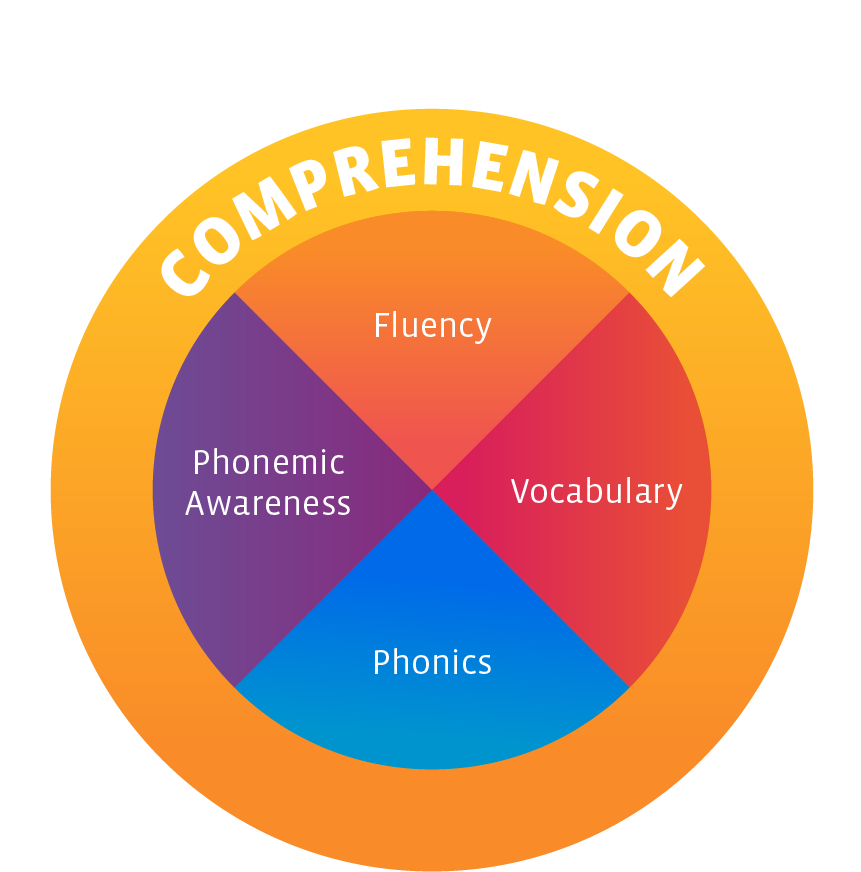 We also know that instruction for each of these components doesn't happen in a vacuum. Students' needs change over time, and effective instruction adapts with them. The flexibility to adjust instruction as students grow has also always been central to the way Read Naturally supports readers. That's why our solutions are designed to help teachers emphasize different components, whether phonemic awareness, phonics, fluency, vocabulary, comprehension, or spelling, based on where students are in their reading journey.
We've been continuing to expand and improve our offerings for over 30 years now. Our programs accelerate reading achievement by providing effective, engaging, and adaptable reading instruction to all students.
Here's how our programs address each component of reading:
Phonemic Awareness
Phonemic awareness refers to a student’s ability to focus on and manipulate sounds (phonemes) in spoken syllables and words. Funēmics is Read Naturally’s phonemic awareness program for small groups of pre-readers or struggling readers. Students gain awareness of words, syllables, rhyming, phonemes, and phoneme manipulation using a research-based, scripted curriculum. Phonemic awareness, phonics, and other foundational reading skills are also taught in our GATE+ program.
"This is a must-have to support your lowest kindergartners who need structured support in phonemic awareness!" —Kassandra B.
Learn more about phonemic awareness.
Phonics
Phonics is the relationship between the letters in written language and the individual sounds in spoken language. Read Naturally provides explicit, systematic phonics instruction in Read Live, the Encore II Phonics Series, Word Warm-ups, and GATE+. We also offer a phonics assessment, Quick Phonics Screener.
"Discover the pleasure of watching your students developing their decoding skills and applying them to their daily readings." —Betty R.
Fluency
Reading fluency consists of accuracy, expression, and rate. To become proficient readers, students need to become fluent with text so that they can pay attention to the meaning. The Read Naturally Strategy builds fluency and is central to our Read Live, Encore II, and GATE+ programs.
"With so many students coming in with dyslexia diagnosis, Read Live has been my support to help target those deficits in phonics and fluency. I’ve videoed one of my students reading a fluency passage and sent it to my SPED Director. She immediately asked how many seats we need." —Patricia P.
Vocabulary
Research-based methods of teaching vocabulary include learning words before reading, repetition and multiple exposures, learning in rich contexts, incidental learning, and use of technology. Read Naturally teaches rich vocabulary using these key concepts in our Take Aim! at Vocabulary, Read Live, Encore II, GATE+, and Splat-o-Nym programs.
"As a Middle/High school Special Education teacher it is challenging to find materials that are high interest/controlled vocabulary. Read Live does a great job with this and also prepares my students for the content vocabulary they will need in science and social studies classes." —Caroline A.
Comprehension
Comprehension is the ultimate goal of reading. To learn comprehension strategies, students need instruction, modeling, practice, and feedback. Read Naturally uses research-based methods to support comprehension development in our Read Live, Encore II, and GATE+ programs. Read Naturally’s newest reading solution, Comprehension Builder, offers targeted lessons on strategies and specific question types.
"Read Live to the rescue! We are seeing many of our at risk students show huge growth in their reading comprehension." —Jodee B.
Learn more about comprehension.
And also...spelling!
A basic spelling vocabulary of 2,800 to 3,000 well-selected words should form the core for spelling instruction. Spelling instruction should be phonics-based, teaching students to take words apart sound-by-sound and write them down letter-by-letter. Our Signs for Sounds program is a systematic spelling program that teaches students to spell both regular and irregular high-frequency words. It also reinforces phonics concepts. Spelling practice is also included in the Read Naturally Live Phonics series and our GATE+ program.
"I have loved using this program for my first and second grade students that I service for basic reading skills. The confidence I see in them being able spell out words independently and use them in their writing has really made my heart happy." —Laurie G.
Our solutions are grounded in research, designed for real classrooms, and built with flexibility and affordability in mind—because all students deserve access to effective reading instruction.
Read Naturally builds strong, confident readers in every area of reading development. Please check out all that we offer, and connect with us for a personalized conversation about how we can help. We’re excited to provide you with the solution you’ve been looking for.
See what educators have to say about Read Naturally's complete literacy solutions:
"Read Live has been lovely, its Read Naturally Live, Word Warm-ups Live, & One Minute Reader Live, cover all the basics: vocab, phonics, sight words, reading fluency, and comprehension...I pray my district adopts it not only for my SPED students, but for the elementary as well, the students would all benefit." —Teresa O.
"My reading students get so much “bang for their buck” with the Read Naturally program. In addition to fluency practice, my students get comprehension, vocabulary, as well as phonics word work in a minimal time commitment. Thank you!" —Amy D.
"Read Live is a fantastic program to build reading fluency, vocabulary, comprehension, and writing with students. Our school uses it daily and the students make gains in all areas mentioned." —Chandra B.
"I have been using Read Naturally for years and I am a big fan. I love the fact that it hits so many target areas all in one program: decoding, encoding, fluency, vocabulary, writing, concrete and inferential thinking....I also really like the data that I can use when writing progress notes on the student's ability in each of those areas." —Kim J.
"Read Live is excellent and we use it a lot to support our weak readers, EAL students who need phonics support and dyslexics. It helps students to speed up their reading, improve comprehension and improve their vocab and is an all-round support for all reading issues. We use it with all ages from year 2 up to year 13 and it is a bedrock of our support system for literacy." —Pauline M.
"My intervention students use the program daily. They love it, and I love the reading gains they are making. Thanks to Read Live, our students can put all their developing skills together to practice everything from phonics and vocabulary to fluency and comprehension." —Heather B.
"Read Live is the solution we've been searching for to deliver differentiated, targeted instruction. It encompasses all the essential components for effective literacy teaching." —Stephanie S.
"The program incorporates the components of the teaching of reading from phonemic awareness to Inferential Comprehension...I can differentiate and individualize the program for any skill level as is essential for any Special Education teacher." —Caroline A.
"As a Title 1 Reading Teacher, we require the use of evidence-based programs to support our diverse population. I highly recommend this program for phonics, fluency, vocabulary and comprehension!" —Katie E.
 Share your student’s success story—nominate him or her for our Star of the Month award. Win a Barnes & Noble gift card for the student and a Read Naturally gift certificate for your class!


Post a New Comment