
 Teachers and administrators comparing digital reading solutions sometimes notice what Read Live doesn’t have: cute or flashy animations, customizable avatars, leaderboards, etc. And it’s an important thing to notice! When students may spend hours a week in front of a screen, what's on that screen is worth a careful look. So let us explain why what's missing is missing on purpose.
The short answer is that the elements that do exist on a Read Live screen are there for a reason: they benefit students and teachers toward the goal of improving literacy outcomes. The longer answer involves a few considerations, chief among them the quality of the motivational elements themselves and the range of students a single interface can serve—both of which shape what we decide to include and what we decide to leave out.
Gamification can earn its place on a digital platform—it isn't inherently a gimmick. But students’ time is valuable, and every second spent engaging with decorative rewards is a second not spent reading. Additionally, the American Academy of Pediatrics reported in January that moderate use of well-designed educational software is associated with academic gains, while heavy use of flashy, distracting media can interfere with a child's emotional regulation. How much a given feature helps or hurts depends on the individual student, but that variation is what can make some of these gamification features a poor bet. They aren't reliably beneficial, and they carry real costs for many students.
There's a related problem that has nothing to do with regulation. Features designed to delight a second grader can alienate an eighth grader—and older students in intervention are often the ones who already feel the worst about being there. A program that looks like it was made for little kids confirms to them exactly what they're afraid of.
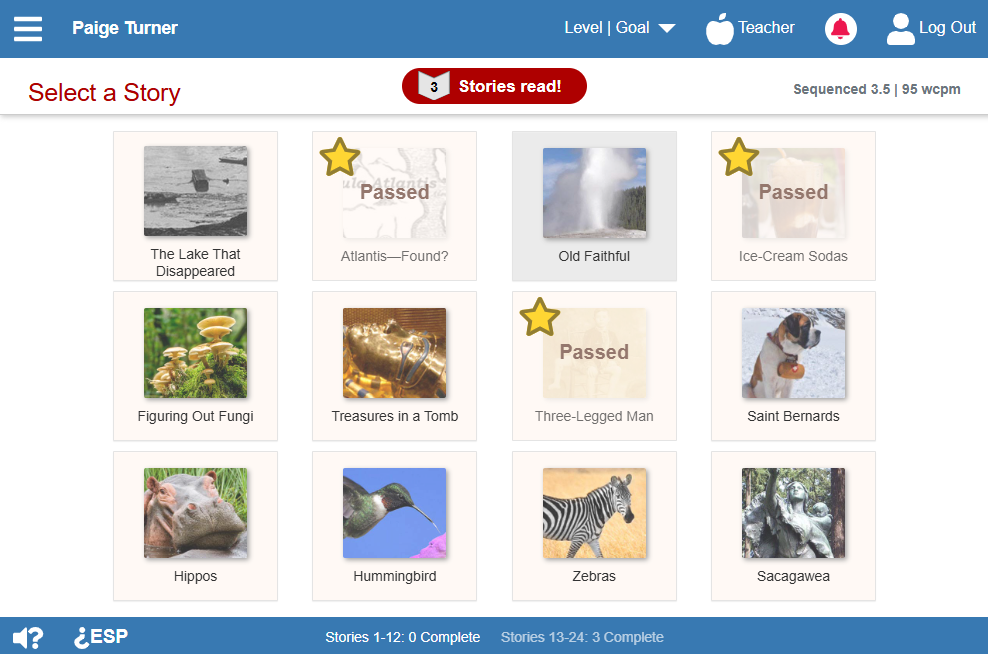 Read Live's clean interface sidesteps both problems: it's not overstimulating or condescending. Instead, Read Live maximizes motivation by tying it as closely as possible to the reading itself. Students get to choose the stories they work through, so they are intrinsically motivated to read for understanding. They get to see their progress in real time on their wcpm graphs, so they realize their efforts have immediate, significant impact. The reward stars and story counter satisfy students’ completion drive, give them milestones to celebrate, and can foster healthy competition that isn’t tied to their varying reading levels. The number of stories students complete each week also factors into the Periodic Assessment of Fluency—one more way to show students that putting in time and effort has a real effect.
The best way to evaluate an interface is to use it. Experience Read Live FREE for 60 days* and see how your students respond. The impact will show up quickly—not just in their reading ability but also in the way they view themselves as readers.
*Sign up for the 30-day trial, then complete your personalized training session to unlock 30 additional days.
 Share your student’s success story—nominate him or her for our Star of the Month award. Win a Barnes & Noble gift card for the student and a Read Naturally gift certificate for your class!

Post a New Comment